Space not available
Reserve this advertising space
Selected ad format
The file format is not recognized
Click here for
upload an ad
Click here to download
an announcement
Here drag and drop or
upload an ad
Send the ad up to 8 days after payment
A link will be sent to you by contact@via-agency.media
Reserved space
Announcement transmitted
Reference
– The forest economy
With a forest area extending over 22 million hectares representing 48% of the national territory, the forest-wood sector is a key sector of the economy, the 2nd contributor to the GDP, with 60 billion FCFA per year in tax revenue.
Space not available
Reserve this advertising space
Selected ad format
The file format is not recognized
Click here for
upload an ad
Click here to download
an announcement
Here drag and drop or
upload an ad
Send the ad up to 8 days after payment
A link will be sent to you by contact@via-agency.media
Reserved space
Announcement transmitted
Reference
An increase of 1,141 million cubic meters of timber harvested from Cameroonian forest concessions is expected by 2030. These harvests are projected at 15 million cubic meters per year, compared to 7 million currently. This increase, corresponding to more than 1,001 million cubic meters, should also lead to a doubling of the timber industry's contribution to GDP.
As a knock-on effect, the number of jobs in the timber industry, which currently stands at 40,000, is expected to increase to at least 100,000, due in particular to the dynamism of local processing. Cameroon aims to increase the number of logs processed in primary processing from the current 75% to 100% and to increase the level of activity in secondary and tertiary processing by 50%.
It should be noted that in November 2022, representatives of the CEMAC governments postponed indefinitely the entry into force of the ban on log exports. This postponement was demanded in particular by Cameroon.
Cameroon's second-generation computerized forest information management system (Sigif 2), funded by German Cooperation and the European Union (EU), could see improvements for greater efficiency. With the implementation of Sigif 2, Cameroon is expected to see an increase in revenue from forest taxes. Thus, a 25% increase in felling tax is projected, due to the control of each forest operator's actual taxable forest production and the consideration of all timber supply sources.
Space not available
Reserve this advertising space
Selected ad format
The file format is not recognized
Click here for
upload an ad
Click here to download
an announcement
Here drag and drop or
upload an ad
Send the ad up to 8 days after payment
A link will be sent to you by contact@via-agency.media
Reserved space
Announcement transmitted
Reference

On March 30, 2022, the Cameroonian government and the World Wide Fund for Nature (WWF) signed a memorandum of understanding to strengthen the integrated management of Cameroon's globally significant forest landscapes in the Congo Basin (GEF7). Over the next six years, WWF will focus its efforts in the south of the country, where swathes of forest are threatened by agro-industrial projects. Funded by the Global Environment Facility (GEF) to the tune of 6.17 billion CFA francs (approximately €9.4 million), the GEF7 project also aims to ensure the biological integrity of forest landscapes in the southern region and increase economic opportunities and livelihoods for local populations. The project targets the areas of Campo Ma'an-Rio Campo (CMRC), the Tri-National Dja-Odzala-Minkebe (TRIDOM) and the Tri-National de la Sangha (TNS), an interzone between Rio Campo and the TRIDOM landscape of Cameroon.
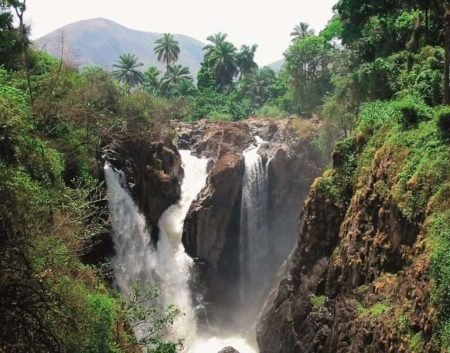
The country, thanks to its 22.5 million hectares of forests, has a storage capacity of 5,043 million tonnes of carbon, or 185 tonnes/hectare.
A rich flora and fauna
More than 900 bird species live in Cameroon. In Waza Park, one of Cameroon's major protected areas, elephants, giraffes, hippos, cheetahs, buffaloes, antelopes, and even lions roam freely. The protection of all species present in the park pays particular attention to the most affected: the elephant, lion, giraffe, sabae python, crowned crane, turtle, Nile crocodile, geese, and their illegal by-products. This wildlife protection primarily involves combating poaching and trafficking of wildlife and wildlife by-products in the Far North region in general and in Waza Park in particular.
To meet gorillas, you must travel to the Mengeme Sanctuary in the southeast of the country. Cameroon is home to some of the most venomous snake species in the world, such as the cobra, the Gaboon viper, and the green mamba.
Due to the diversity of terrain—tropical forest, steppe, and savannah—the landscape varies from region to region. In the savannah, amidst more modestly sized trees, the baobab reigns supreme. Its size and diameter detract from its incredible elegance.
Space not available
Reserve this advertising space
Selected ad format
The file format is not recognized
Click here for
upload an ad
Click here to download
an announcement
Here drag and drop or
upload an ad
Send the ad up to 8 days after payment
A link will be sent to you by contact@via-agency.media
Reserved space
Announcement transmitted
Reference